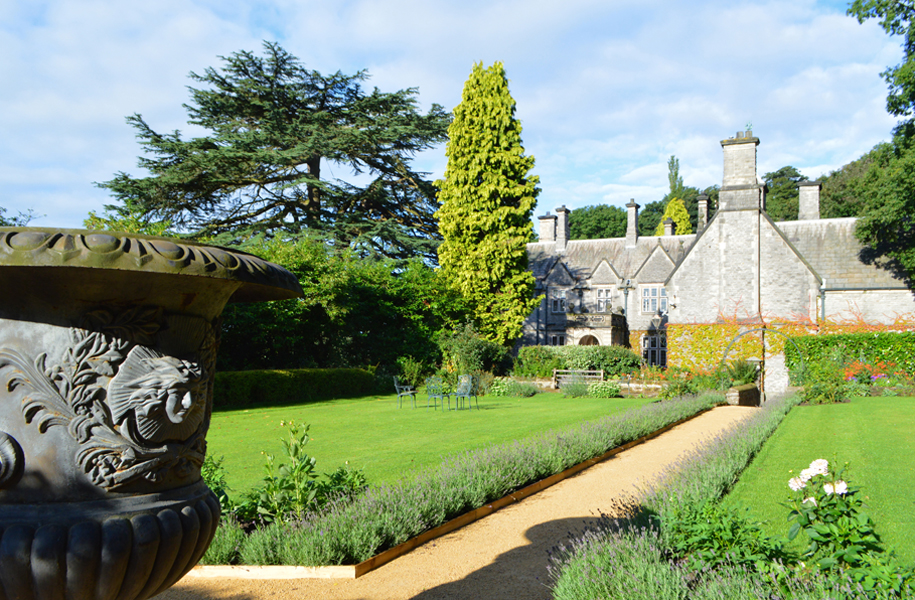
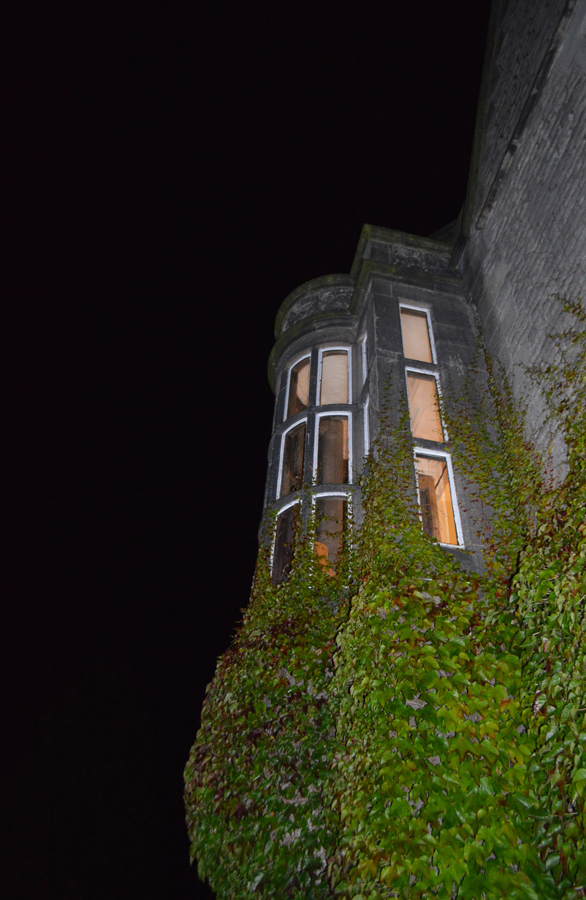
Categories
Architects Architecture Country Houses

Auchinleck House Ayrshire + The Landmark Trust

Landmark Ruling

1 Auchinleck House Landmark Trust copyright lvbmag.com

The story of the present building, the spirit of the age, begins with Lord Auchinleck, father of James Boswell, the celebrated blogger diarist and biographer of Samuel Johnson. Lord Auchinleck, aka Laird No.8, received his non hereditary title in recognition of his appointment as a judge in the High Court of Scotland. This uplift in social status required an upgrade of house on the family estate he used as a retreat when the Edinburgh courts were in recess. The current building is the third house to be constructed on the estate which was granted to Auchinleck’s forbearers in the 14th century.

2 Auchinleck House Landmark Trust copyright lvbmag.com

His choice of the neoclassical style originated from a deep seated love of the classics rather than merely following voguish architectural whims. He regularly identified with the writings of Horace. A frequent Horatian theme is the pleasure of fulfilling life in one’s own, usually rural, locale. The epigram presiding over the entrance front pediment encapsulates this approach to living: “Quod petis, hic est; est ulubris animus is te non deficit aequus.” Or, “What you seek is here in this remote place if you can only keep a steady disposition.”

3 Auchinleck House Landmark Trust copyright lvbmag.com

The emblems carved on the pediment represent aspects of the cultivated mind, all of which could be expected to find expression in a house evoking an aesthete’s villa. Music, martial arts, scales of justice, a sceptre of authority and the serpent entwined staff of Aesculapius the healer are all represented. They are grouped round the central motif, a hooded falcon from the Boswell family crest.

4 Auchinleck House Landmark Trust copyright lvbmag.com

The Duchess of Northumberland sniffily dismissed the decoration of the pediment in her 1780 diary as “terribly loaded with Ornaments of Trumpets and Maces and the Deuce knows what”. As for the house itself, she found it to be “but a middling house, but justly it is a romantick spot”. Phew.

5 Auchinleck House Landmark Trust copyright lvbmag.com

Until recently the architects were assumed to be the Adam brothers. They designed the contemporaneous neighbouring Dumfries House. Lord Auchinleck records a jaunt to the Earl of Dumfries at Leifnorris in a letter of 1753 “where politicks and house building made the subject of conversation at a plentiful dinner”. An investigation of the Boswell Papers at Yale Manuscript Library suggested Auchinleck House was most likely designed by the Edinburgh based square-wright John Johnston with a heavy helping hand from the good Lord himself.

6 Auchinleck House Landmark Trust copyright lvbmag.com

Johnston was a protégé of Sir John Clerk of Penicuik, author of The Country Seat and instrumental in promoting the ethos of the villa in Scotland. It’s a triumph of balance, symmetry and proportion. Whether the product of one or more minds, an intelligence and creativity of the highest order is apparent. Estate manager James Bruce wrote to Boswell in 1758,

7 Auchinleck House Landmark Trust copyright lvbmag.com

“The building is going on: tho’ slowly by reason of few hands, the reason of which was, before a full determination was fixed on, masons was all taken up as a vast worke is carrying on in this country by these great Naboos.”

8 Auchinleck House Landmark Trust copyright lvbmag.com

Quite.

9 Auchinleck House Landmark Trust copyright lvbmag.com

Another account from this period reported that Lord Auchinleck built his house “so slowly and prudently, that he himself hardly felt the expense”. The General Ledger of the Bank of Scotland reveals that Lord Auchinleck took out Bonds of Credit for £500 and £1,000 between 1759 and 1762. Expenditure on the estate peaked between 1758 and 1760. Window tax for 31 openings was first paid on the house in 1760. Daylight robbery! Boswell’s son was more than happy with his new home, writing on 30 March 1767 to his friend William Temple,

10 Auchinleck House Landmark Trust copyright lvbmag.com

“This is a superb place: we have the noblest natural beauties and my father has made most extensive improvements. We took 10 miles out upon our dominions. We have an excellent new house. I am now writing in a library forty foot long. Come to us, my dearest friend.”

11 Auchinleck House Landmark Trust copyright lvbmag.com

Estate journals confirm that the four pavilions flanking the house were not added until 1773 although they always seem to have been intended. The pavilions contrast with the main block in material and style. The idiosyncratic sexiness of their silhouette, as distinctive as a Philip Treacy hat, suggests a fondness for the Vanbrugh school of drama. Boswell refers to the finished pavilions in his August 1775 journal as “newly whitened”. This would have disguised the variation between their rosy sandstone and the gentler grey limestone of the main block. In authentic Palladian style, the pavilions weren’t just decorative additions but were utilised as estate outbuildings.

12 Auchinleck House Landmark Trust copyright lvbmag.com

Lord Auchinleck lived in splendid isolation to the ripe old age of 75, becoming increasingly cantankerous and garrulous. Not so Horatian after all. James Boswell was 41 when as Laird No.9 he inherited the estate in 1782. He made no changes to the house, presumably too busy writing and getting sozzled. Boswell did though progress his father’s planting scheme. Auchinleck House continued down the Boswell line in the 19th century with no subsequent descendents bothering to alter it. One exception was a family member who took with gusto to tarting up the dining room as a parlour, patterning the room to within a square inch of its life.

13 Auchinleck House Landmark Trust copyright lvbmag.com

The house passed by marriage to the Talbot family who packed their suitcases for Malahide Castle in 1905. They dispersed its contents and in the 1920s the house was sold to a distant branch of the family named Douglas-Bothwell. It fell into sober decline for the rest of the 20th century until in 1986 the owner, another James Boswell, sold the house with 14 hectares to the Scottish Historic Buildings Trust. The Trust made the house watertight but struggled to find a role for it in the face of development proposals for the rest of the site. In 1999 the freehold was transferred to the Landmark Trust. And so began the Landmark Trust’s largest restoration to date. Raise your glasses!

14 Auchinleck House Landmark Trust copyright lvbmag.com

Lavender’s Blue wish to thank the Landmark Trust for their extensive research which we have shamelessly ploughed, plundered, pillaged and plagiarised our way through while adding a pinch of personal panache.

15 Auchinleck House Landmark Trust copyright lvbmag.com

Peasant Shoot

16 Auchinleck House Landmark Trust copyright lvbmag.com

Lights, cameras, action! Lavender’s Blue stayed at Auchinleck House this summer for an exclusive photo shoot. Taxi at dawn across the capital (not that we’re tired of London), Virgin train to Carlisle, two hour drive through lashing rain to Eden Lake Auchinleck village, 10 minute detour getting lost on the estate… and we still managed to arrive just in time to experience a glorious Scottish sunset.

17 Auchinleck House Landmark Trust copyright lvbmag.com

First glimpse of the house is the beguiling west elevation across a meadow. A haha conceals the raised basement from this perspective. Sweep round the driveway, past the long east elevation, and entry is via a porch to the side at basement level. Side on, the house resembles a Georgian three storey townhouse. A corridor bisects the floorplan of both the basement and bedroom floor like arteries running through the heart of the building.

18 Auchinleck House Landmark Trust copyright lvbmag.com

The former kitchen is now a table tennis room with stone vaults ideal for whacking the ball off. A dumb waiter to one side of the hearth is a reminder of the room’s original use. Stone steps from the corridor wind up past a bathroom, with a window immodestly level with the front driveway, to the dramatic full height staircase towering up to an elaborate plasterwork ceiling. This space is not huge by country house standards, especially considering it contains the only staircase for use by master and servant alike. In fact although large by modern standards, Auchinleck House exudes a charming air of compact intimacy.

19 Auchinleck House Landmark Trust copyright lvbmag.com

The staircase hall leads directly into the squarish entrance hall, beautifully lit by the glazed front door. This space occupies the central bay of the piano nobile along the east front. A panelled breakfast room with a fireplace tipsily set at a 45 degree angle continues the east front enfilade culminating in the grand dining room. This room was designed to impress. The smaller proportions of the breakfast room, which in effect is an ante room, give way to a space spreading across the full width of the house with windows on three sides. Its higher ceiling is accommodated by shrinking the floor to ceiling height of the bedrooms above, meaning their sashes skim the floor like crinoline skirts.

23 Auchinleck House Landmark Trust copyright lvbmag.com

Auchinleck’s acme; Beethoven’s 9th in architectural form.

20 Auchinleck House Landmark Trust copyright lvbmag.com

The flow of connecting spaces continues with another door towards the back of the house leading from the dining room into the relocated kitchen. The enfilade along the west front mirrors that of the east. The veiny marble fireplace in the kitchen looks like carved blue cheese. Another door leads back into the entrance hall. The third room off the entrance hall is the principle bedroom with a magnificent four poster bed. This room leads into a single bedroom and the final room along the west front is a corner bathroom.

21 Auchinleck House Landmark Trust copyright lvbmag.com

In a circular fashion, the single bedroom also opens into a panelled morning room and then back into the staircase hall. This layout is a late example of the Grand Apartment with Parade Planning circulation from one room to another, flowing from public to private quarters.

22 Auchinleck House Landmark Trust copyright lvbmag.com

Five bedrooms open off the first floor corridor. En suites have been carved out of dressing rooms and the thickness of the walls cleverly accommodates alcoves, cupboards, blind doorways and even a couple of small stone basins. Steps at one end of the corridor ascend to the two bedroom suites over the dining rooms. Their lower ceilings lend them a cottagey feel.

24 Auchinleck House Landmark Trust copyright lvbmag.com

The impressive crimson painted library fills the full length of the four bay breakfront on the west elevation, with views onto the meadow far below, the countryside reaching out to infinity beyond. In 18th century Scotland the first floor was the approved location for a gentleman’s library. Little wonder.

25 Auchinleck House Landmark Trust copyright lvbmag.com

Lavender’s Blue are the latest in a long line of noble notable visitors to the estate. In January 2012, Owen Patterson, Secretary of State for Northern Ireland, and his wife Rose Ridley, daughter of the 4th Viscount Ridley, stayed at Auchinleck House. Everybody’s changeling.

26 Auchinleck House Landmark Trust copyright lvbmag.com

27 Auchinleck House Landmark Trust copyright lvbmag.com

28 Auchinleck House Landmark Trust copyright lvbmag.com

29 Auchinleck House Landmark Trust copyright lvbmag.com

30 Auchinleck House Landmark Trust copyright lvbmag.com

31 Auchinleck House Landmark Trust copyright lvbmag.com

32 Auchinleck House Landmark Trust copyright lvbmag.com

33 Auchinleck House Landmark Trust copyright lvbmag.com

34 Auchinleck House Landmark Trust copyright lvbmag.com

35 Auchinleck House Landmark Trust copyright lvbmag.com

In Good Spirits

36 Auchinleck House Landmark Trust copyright lvbmag.com

Extract from James Boswell’s merry Book of Company at Auchinleck 1782 to 1795 edited by Viscountess Eccles and Gordon Turnbull.

37 Auchinleck House Landmark Trust copyright lvbmag.com

“When Boswell succeeded his father as laird of Auchinleck in 1782, he became a person of significance in Ayrshire society and he resolved to fill his position with dignity and sobriety. His journals for earlier years are full of references to what has been aptly described as ‘deep drinking, appalling hangovers, profound repentance… and deep drinking’ but now, as he told Johnson: ‘It was my determination that I should maintain the decorum of the representative of Auchinleck and I am doing so.’ He had drunk little since his bout of influenza earlier in the year and the record in the Book of Company shows that, for the first few months of his lairdship, consumption of wines and other liquors at Auchinleck was indeed quite moderate. Thus, when Sir John Whitefoord came to dinner on 12 October 1782, only a single bottle of claret was drunk, and Boswell recorded in his journal:

38 Auchinleck House Landmark Trust copyright lvbmag.com

‘I had almost broke through my sober scheme of life, as we were tête-à-tête and it was the first time he had been in my house since my succession. But I checked myself. Indeed my wish to drink with him was not from love of wine and intoxication, as has frequently been the case with me, but from a desire to be cordial. He excused me, and drank claret easily while I took wine and water.’

39 Auchinleck House Landmark Trust copyright lvbmag.com

The ‘sober scheme of life’ did not last for long. By the end of the year, Boswell’s good spirits were beginning to crumble and his moderation lapsed. On 3 January 1783, he visited Eglinton where he enjoyed some old Malaga, ‘and finding I really had liberty to drink as I pleased, my heart dilated and I drank two bottles, all but three glasses.’ The next morning he noted: ‘awaked very ill, and was somewhat vexed that I had not been able to maintain my sobriety even at Eglinton.’

40 Auchinleck House Landmark Trust copyright lvbmag.com

After this, Boswell did not return to Auchinleck until August 1783. There, during the ensuing three months, as the ‘Book of Company’ shows, he entertained numerous guests who were treated to generous, indeed at times extraordinary quantities of liquor. He wrote in his journal:

41 Auchinleck House Landmark Trust copyright lvbmag.com

‘A great variety of other company was at Auchinleck. I felt the entertaining of them in general was a laborious and anxious task. I several times drank too much wine, and suffered severe distress after it. I was quite averse to writing. I was exact only in keeping my Book of Company and Liquors, in which I marked with more regularity than I supposed possible for me all the company with us at dinner in one column, and all night in another, with the different liquors drank each day in separate columns.’

42 Auchinleck House Landmark Trust copyright lvbmag.com

Over many years, Boswell had reacted to his own concern about excessive drinking by noting how much he drank and its effect on him. This may have been one of his reasons for combining the record of his guests at Auchinleck with a detailed arithmetical account of every bottle of wine or other liquor consumed. It was as much a discipline aimed at keeping his drinking under control as an aid to the efficient management of his cellar. But the discipline, though it may have served to focus Boswell’s attention on his own over-indulgence, did not prevent it. The statistics speak for themselves: on 16 October 1783, with six guests for dinner and overnight, the consumption totalled 19 bottles (seven bottles and two Scotch pints of claret [equivalent to 11 bottles], three bottles of port, one of Lisbon, two of Madeira, one of mountain, and one of rum); and the following day, 17 October, with seven guests, the tally came to 20 bottles (11 equivalent bottles of claret, three of port, two of Lisbon, one of Madeira, and three of rum). Amazingly, Boswell escaped his usual hangover and was able to write: ‘I drank a great deal of wine without feeling any bad effect. While I kept the highest pitch of jollity, I at the same time maintained the peculiar decorum of the family of Auchinleck.’

43 Auchinleck House Landmark Trust copyright lvbmag.com

The record of liquors begins tidily enough in September 1782, with consumption neatly recorded in 10 separate columns headed: Port, Lisbon, Sherry, Madeira, Mountain, Sitgis, Gin, Brandy, Rum. Of these, Lisbon, mountain and Sitgis are virtually unknown to modern wine drinkers […]. Although Boswell kept whisky at Auchinleck, it does not appear in the Book of Company, for it was not at that time a drink for the gentry nor one which they would normally have offered to their guests.44 Auchinleck House Landmark Trust copyright lvbmag.com


The record is kept reasonably well and conscientiously until the end of 1783, although Boswell’s arithmetic in summing his columns is sometimes wrong. Not surprisingly, he was taking arithmetic lessons from Alexander Millar, his domestic chaplain and his son’s tutor. However, his arithmetic is not always as bad as may at first appear. A Scotch pint of claret was roughly equivalent to three imperial pints. Boswell thus counts a pint as though it were two bottles in totalling his columns. Other letters of symbols appear on the record which cannot be confidently explained. These take the form of H, J (or possibly I), and a symbol that looks like a narrow upright oval. The H is marked against certain bottles of claret consumed in September and October 1783; and the other letters or symbols appear against certain bottles of both claret and port consumed during the same period. in a modern wine list, H often signifies half a bottle, but half-bottles were not normally supplied by wine merchants at that time. Furthermore, if Boswell counted a Scotch pint as two bottles in summing his columns, one would have expected him to count two bottles marked H as one, if indeed they had been half-bottles. This does not occur. Perhaps H indicates claret supplied by John Hamilton, of Bogle & Hamilton, Glasgow, one of his regular wine merchants; perhaps it identifies the storage location from which it was taken – for example the hall cupboard (which according to a list of Liquors at Auchinleck of 1794, was used for the storage of wines). One can speculate similarly about the other markings, but it is impossible to reach any firm conclusion as to what they signify.

46 Auchinleck House Landmark Trust copyright lvbmag.com

After 1783, the record of consumption begins to deteriorate. Boswell gives up adding columns and ceases to carry forward the totals from page to page. After January 1785, he abandons the record for the remainder of the year. The columns are still marked, but they are left blank and unheaded. A scrappy and incomplete record resumes in 1786, with the column headings reduced in number, no totals, and consumption frequently is abandoned altogether until 1793, apart from a few entries in April, May, and July 1789. The record begins again on 2 March 1793 with only three columns, headed Port, Mountain and Punch, to which Boswell later adds columns for Sherry, Claret, and Rum. The record finally peters out for good in August 1794.

47 Auchinleck House Landmark Trust copyright lvbmag.com

That same month, on 22 August 1794, Boswell wrote out a list of Liquors at Auchinleck. This is interesting because it shows how meagre the stocks were at that date. Apart from a reasonable supply of mountain (i.e. some Malaga) and some Madeira, there were only a few bottles of drinkable claret and some oddments. There were a dozen bottles of whisky dating back to 1783 which Boswell kept in his counting room (presumably for his estate employees and probably seldom resorted to). It is odd that such a modest quantity of liquors could not all have been accommodated in the cellar as such, but bottles appear to have been stored in presses or cupboards all over the house: in the family bedroom, in the dressing room, in the hall, and in the counting room.

48 Auchinleck House Landmark Trust copyright lvbmag.com

It is clear that when Boswell compiled his list of Liquors at Auchinleck, the cellar was in a badly depleted state and quite inadequate for a substantial country house where guests were to be entertained. But when Boswell returned to Auchinleck from London on 1 July 1794, it was with a firm resolve to be sober, and this would not have been helped by replenishing his stock of wines. On 14 July he wrote to his son Jamie:

49 Auchinleck House Landmark Trust copyright lvbmag.com

‘I have not drunk half a bottle of wine any day since I came here, some days not more than two glasses, some none at all. This moderation I am convinced has produced a calmness in my blood and spirits very different from the effects of too free living in the metropolis.’’’

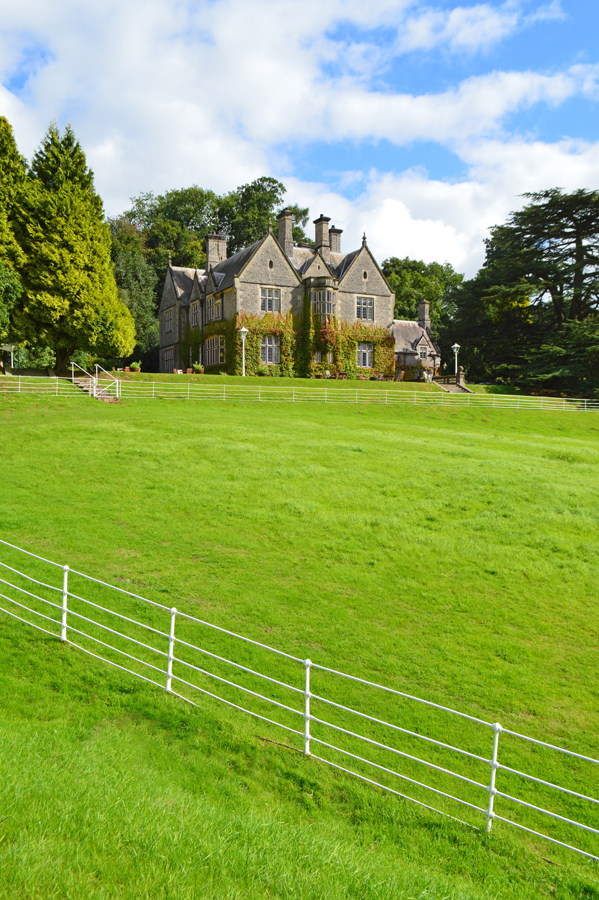
50 Auchinleck House Landmark Trust copyright lvbmag.com

Categories
Architects Architecture Country Houses Developers

Roehampton House Roehampton London + St James

Making the Grade

1 Roehampton House copyright Stuart BlakleyQuestion. What are the only two Grade I Listed Buildings in London to be converted into apartments? Answer. St Pancras Hotel, King’s Cross (the upper floors) and Roehampton House, south London (all of it). They couldn’t be more different. Harry Potter versus Brideshead. Northanger versus Mansfield. Gothic versus baroque. St Martin’s versus Queen Mary’s. Gritty regeneration hotspot v leafy southwest suburbia. The one thing they do share, along with all fellow listed buildings, is the challenge of adapting to suit contemporary lifestyles. Dreaming up a bedroom out of a circular space for Apartment 15 was just one minor Roehampton House brainstorming success. An island of wardrobes backing onto a freestanding wall solved the what-about-storage and where-do-we-put-the-bed dilemma in one fell swoop.

2 Roehampton House copyrioght Stuart BlakleyCity boy Thomas Cary seemingly built the original block in 1713. Thomas Archer was the architect. City boy Arthur Grenfell seamlessly added new wings in 1913. Edwin Lutyens was the architect. City developer St James seamlessly reimagined the enlarged house as 21 apartments in 2013. Nick Davies was the architect. This heritage asset has never looked hotter, set off by pristine landscaping. Not a leaf out of place. The twin gatehouses have been revived and six contemporary garden villas continue the fine building tradition. Now for more questions and answers with the latest architect to display his talent at Roehampton House.

3 Roehampton House coproght Stuart Blakley

Why did you choose to buy and develop this site considering the inevitable costs and constraints of retaining a Grade I Listed Building?

4 Roehampton House copyright Stuart Blakley“When Roehampton House and the former Queen Mary’s Hospital site came to the market, St James was the only organisation from the parties bidding who recognised that once restored the house could create real value. Plus it is a magnificent setting and centrepiece for the adjoining new development. All the other parties saw the house as too great a challenge. St James was the only party who was serious about taking on the restoration and conversion of the Grade I historic building.”

5 Roehampton House copyright Stuart BlakleyWhat were the specific challenges relating to retention and conversion of the Listed Building? 6 Roehampton House copyright Stuart Blakley“Grade I Listed Buildings are comparatively rare. They comprise less than three percent of all Listed properties and in law everything extant at the point of Listing is protected. As with all older buildings, many changes and additions had been made over the years. The challenge of unravelling what should be retained and what can be changed is a long process of evaluation and discussion with English Heritage and the local borough conservation team. There was a desire to restore many of the original rooms that had been subdivided to their original proportions, particularly the panelled rooms that had survived in the Georgian part of the building. St James removed an intrusive steel frame which had been put into the building to strengthen it in the 1980s and had destroyed much of the historic structure. We also needed to put approximately 50 new bathrooms and nearly half as many kitchens into a building which had had very few services whilst preserving and conserving as much of the surviving historic fabric as we could. That was quite challenging.”

7 Roehampton House copyright Stuart BlakleyDid you have to make any specific compromises to ensure compliance with the recognised heritage asset status of the Listed Building?

8 Roehampton House copyright Stuart Blakley“The surviving pleasure grounds and walled gardens have been restored to their former glory and provide both the setting for the house and the framework around which the masterplan for the new surrounding development was shaped. The houses and apartments are traditional in design but not direct copies either in style or materials of the house itself. They also provide the transition between the character of the historic house and the adjoining suburban roads of Roehampton village which were developed in the early 20th century.”

9 Roehampton House copyright Stuart BlakleyDid the Listed Building context add value to the development as a whole?

“Although the costs of restoring a building such as Roehampton House are very significant, the sales values per square foot generated for the apartments have exceeded new build values so there is a genuine cachet for living in this type of historic property. It is also hard to quantify how much uplift the setting of the house has given to the sales prices in all the adjoining new properties but clearly they have also benefited from the overall setting and sense of place… their values reflect this. As with all historic buildings many of the problems you will encounter remain hidden from view. Control of costs is very hard with these unknowns. Many however can be anticipated with proper research and investigation into the history of the building. Using the right professional consultants and sourcing craftsmen skilled in historic building construction techniques is vitally important in managing this process and winning the support of English Heritage and the conservation officers.”

Why was such a contemporary style chosen specifically for the garden villas and how did the setting influence their final design?

“The design of the garden villas evolved from the discussions with English Heritage. Firstly, the rebuilding of the boundary wall on the north side of the pleasure grounds to reinstate this feature at the rear of Roehampton House had left a small piece of land. This land is sandwiched between the site boundary and the new hospital to the north. The original hospital buildings had in fact encroached into the area of the historic pleasure grounds. A key part of our planning strategy was to reinstate the grounds to safeguard the future setting of the house. English Heritage was very keen for this too so that the original frontage of the house could be kept clear of vehicles. To finance the cost of underground car parking it was agreed that a suitable form of development could be designed for the area now occupied by the villas. English Heritage was keen not to confuse the history of the house. It felt that a very simple contemporary design solution which sits quite low behind the wall and is quite self effacing is therefore an appropriate architectural response to the setting of the building. This raises all sorts of views about whether buildings in close proximity to listed buildings should be in the manner of them or totally contrasting and of their time. These are the philosophical discussions you always get into in matters of conservation.”

10 Roehampton House copyright Stuart Blakley

Are there any lessons that were learned from this project which St James will be applying to future projects?

11 Roehampton House copyright Stuart Blakley

“In restoring the building we had to respect the original hierarchy of the rooms in the house and the level of decorative detail that would have been present in these which we could put back, even where this had entirely disappeared during subsequent alterations in its later history. This even extended to us undertaking a full historic paint analysis of the most historic panelled rooms to understand the original decorative schemes that had existed when the house was built. There were three centuries to inform our choice of colours for decoration. Many of our big cost items were still hidden from us behind historic construction that we could not disturb prior to acquisition. If it can be arranged, pre acquisition survey work is essential in minimising risk and cost overruns. Even with the best knowledge it is not possible to anticipate all the problems you may encounter as you peel back the layers of history.”

12 Roehampton House copyright Stuart Blakley

What type of purchaser has been attracted to this development and do they differ from other St James developments?

13 Roehmapton House copyright Stuart Blakley

“So far we have experienced a particular interest from local residents looking to stay in the area but downgrade on size. This is noticeably different to other St James developments which attract a more international audience. Perhaps because of Roehampton House’s heritage and Grade I listed status it draws more British buyers. This could also explain the interest from retired couples who like the idea of living in a grand country home but don’t want the upkeep.”15 Roehampton House copyright Stuart Blakley

Categories
Architecture Country Houses Developers Hotels Luxury People Restaurants

The Carriage Rooms + Montalto Ballynahinch Down

Building It Up

Developed by an early whim of nature, Montalto is imagined to mean ‘high hill’. A sloping driveway rises past brick huts, a hazily remembered transition of the estate’s occupation by American soldiers during the Second World War. A breath of golden haze hovers idly above the sweep of lawns and lake and gardens. Here and there clusters of oaks form delicate groves of shade.

Ahead, beyond a car park sensitively planted with semi-mature trees, are The Carriage Rooms, a complete, quite perfect thing of beauty, flowing in an even line. This new-born riot of dreams evolved from the keen minds of the clients, Gordon and June Wilson, and the confident logical voice of the architect, John O’Connell. It all began with the 1850s mill, special in a building of special events. Three of the Wilsons’ offspring held their weddings in its unconverted splendour. An idea was born.

Once it was a one stop shop serving the 11,000 hectare Montalto estate and adjacent town of Ballynahinch. A saw workshop occupied the undercroft with a threshing mill overhead. Now it is a one stop shop for wedding ceremonies, suppers and dancing. The beauty of things, lights and shadows, motions and faces, provide quick sensory impressions against the tapestry of charcoal grey cut stone and burnt red brick walls.

Like Montalto House itself, the semi basement level of the mill was excavated during conversion to increase penetration of natural light into the interior. As a result, the front arched window overlooks the chiselled wonder of rocks. “That view acts as a reminder to bridal parties that marriage should be built upon rock solid foundations!” jests David Anderson OBE, manager of Montalto House. A wall has been constructed behind the outcrop to prevent glimmering parallels of light from vehicles in the car park roaring across the room.

Brick piers and beams conceal air vents in the main space. To one side, a vaulted passageway leads to the crisp darkness of the plant room. The air vent above this streaked artery is exposed to create a more contemporary look. On the other side, a little vaulted bar is lit by a trio of lunette windows. The gradual gradient of a disabled access ramp doubles as a standing area. Candle niches are carved out of the walls.

“Everything is right, purposeful and has a practical use,” remarks David. “It’s all about delivery of the product. Storage is cleverly incorporated throughout to allow events to flow unhindered.” He confirms The Carriage Rooms are not just for weddings but are also aimed at the conference and performing and visual arts markets. “It’s all about creating an elegant lifestyle,” David adds. “We’re offering a very high end pre-finished product, right down to carefully chosen silver and glassware.”

He continues, “Quality at every angle is what sets us apart. We have a tried, tested and trusted relationship with our recommended catering partner Yellow Door.” Guests can stay over in the gorgeous quarters of Montalto House, the former residence of the Wilsons. Their market research included jaunts to other top notch locations like Ballywalter Park, Belle Isle and Crom Castle. Grandson of Fred, the great FG Wilson, managing director David Wilson’s accountancy skills and venue manager Keith Reilly’s organisational acumen add to the equation equalling success. The Carriage Rooms have become a race apart. There are no plurals.

Attached to the former mill is a smart new two storey rendered block portraying a pleasing preponderance of wall over window. A glazed door opens noiselessly into the magnificence of the entrance hall. Fresh and vigorous, this hall derives its resonance from its very articulateness. The yellow glow and blue shadows of an open fire flicker across its symmetrical features.

The conference room links the entrance hall to the 1850s building. It is a radiantly imagined intervening parlour of politeness. The ceiling is formed of rows of brick and tile vaults. “You won’t find wall to wall Colefax and Fowler here!” jokes David. Instead is a robustly rural neoclassicism – brick cornices, carriage lamps, steel capped beams and granite fireplaces surrounding chamfered cast iron insets – perfecting a brilliant, permeating symbolism.

The double height staircase hall adjoins the entrance hall. Cantilevered granite flights of stairs climb in radiance, overlooked by the translucent feminine languor of upper level Juliet balconies. Accessed off the staircase hall is a discretely placed lift lobby.

The threshing mill is now the banqueting hall: somewhere to lunch on trout, avocado and a pint of Californian wine. “It has a great view from every window,” observes David. Several of the brick arches were reopened, the barn doors downgraded to shutters. The difference in levels becomes apparent in this room which is first floor to the front but opens onto the stable yard at ground level to the side. An arrangement of interior lights at the top makes a sort of floating fairyland. Under the high ceilings the situation seems so dignified.

Lunching together en masses, warmed with liquor as the afternoon begins, floats airy, inconsequential chatter and high-pitched laughter, above all the banqueting hall is another reminder of John’s love of the symmetric. Short hallways on either side of the ground level elevation lead to neat single bay single storey singular pavilions of projecting perpendicularity. One links to the kitchens; the other to the bride’s bathroom.

Symmetry, harmony and balance reach an apex on a central axis in the brick faced orangery where indoors meets outdoors. Below the parapet, pairs of French doors surmounted by fanlights fragmented by umbrella spike glazing bars open gracefully onto a terrace. The wealthy, happy sun glitters in transient gold through the thick windows of this magical, breathless room. A curious lightness permeates the rarefied air. This is a room where the solid, soft gold of the walls yields to the greenery of the exterior. It dazzles the eyes. “This is The Carriage Rooms’ architecture at its most formal,” notes David.Beyond lies the walled garden, fragrant with a host of flowers, a place for promenaders on a protracted circuit to digest sandwiches and sundaes eaten for lunch. The troubles of the day can arrange themselves in trim formation in this civilised setting. Annexed off it, crowded with planets and nebulance of cigarettes, is the smoking area, half enclosed by a symmetrical sweep of fencing. A narrow path that winds like a garter round the building descends towards the entrance front for a few more gorgeous moments.

Subtle and intricate, The Carriage Rooms exude a confident charm. A white radiance is kindled that glows upon the air like a fragment of the morning star. It is a place for débutantes, rakes and filles de joie to accept the wealth of high finance and high extravagance. The Carriage Rooms are a venue to deliver extreme happiness in the awakening of flowing souls.

Categories
Country Houses

English Heritage + Eltham Palace London

Style Collision1 Eltham Palace © lvbmag.com

Some buildings are so ugly they are just asking to be covered by Christo and Jeanne-Claude (the artists who wrapped the Reichstag a while back). With others, it’s down to a matter of personal taste. Take Tate Modern‘s plans for an extension designed by Herzog and de Meuron, the team that conjured up the original gallery from a former power station. The gallery’s monumental success wasn’t planned for and the new extension would offer much needed space to breathe.

2 Eltham Palace © lvbmag.com

But the 11 storey ‘ziggurat’ as everyone’s calling it, would apparently ruin views that no one gave a toss about until the Tate Modern came along. It may be that some of the sniping is part of the backlash against the grandiose projects of the ‘starchitects’. The furore is enough to make the 1960s controversy over Francis Pym’s bold and brilliant Brutalist extension to the Ulster Museum look mild. Recently, plans to enlarge this 20th century modernist wing caused a stir. Not to mention painting the concrete ground floor wall white. Sacrilege.

3 Eltham Palace © lvbmag.com

When it comes to houses, things get even worse. They are not so much castles as minefields. We left the caves for our first built homes about 11,000 years ago yet there still is no general consensus on domestic architecture. Gustave Flaubert said all architects are imbeciles because they are always putting stairs in the wrong place.

4 Eltham Palace © lvbmag.com

In the 1930s Eltham Palace attracted lots of architectural criticism. Initially, Seely + Paget’s proposal for resurrecting the ruinous medieval royal palace was welcomed as a means of halting the creeping suburbanisation of southeast London. There was, of course, inevitable debate surrounding the propriety of building on an ancient monument. But it was the design of the Courtaulds’ new house that polarised opinion.

5 Eltham Palace © lvbmag.com

A leading article in Architect and Building News was headed “Romance dies at Eltham.” The architect Herbert Baker was critical; the artist Gilbert Ledward countered, pointing out that at Soane’s Bank of England building Baker had destroyed ‘really beautiful work, while at Eltham everything of historic interest and beauty had been saved’.

6 Eltham Palace © lvbmag.com

More criticism came from the historian George Young who moaned in The Times, “In order to provide the tenant with a modern mansion, three distinguished architects [Chief Inspector of Ancient Monuments Charles Peers acted as a consultant for Seely and Paget] united their talents and intelligence to destroy one of the most beautiful things remaining in the neighbourhood of London … The other day I found myself confronted with what at first I took to be an admirably designed but unfortunately sited cigarette factory.”

7 Eltham Palace © lvbmag.com

8 Eltham Palace © lvbmag.com

9 Eltham Palace © lvbmag.com

10 Eltham Palace © lvbmag.com

11 Eltham Palace © lvbmag.com

12 Eltham Palace © lvbmag.com

13 Eltham Palace © lvbmag.com

14 Eltham Palace © lvbmag.com

15 Eltham Palace © lvbmag.com

16 Eltham Palace © lvbmag.com

We chatted to Jon Wight, caseworker for The Twentieth Century Society, about changing taste in architecture and how to sway it. “The Society was founded in 1979 as The Thirties Society and indeed Art Deco buildings were one of its first major concerns, alongside other buildings from the Modern Movement. In many ways that battle has been won. We became The Twentieth Century out of necessity to try and give weight to buildings from later periods.”

17 Eltham Palace © lvbmag.com

“We strive to inform, educate and promote 20th century architecture to the public wherever possible,” says Jon. “There are other reasons why the Society has registered as shift in public perception. Most obviously, the older a building or style is, the easier it is to assess. We’re now reaching a stage where post war buildings are being looked at and considered in a way they’ve not been before.”

18 Eltham Palace © lvbmag.com

“There are many styles of architecture that are not seen as important at the time of construction, but which subsequently become revered,” he continues. “The Society strives to judge buildings on merit, through the medium of casework. We are concerned as much with the re-appropriation and re-use of buildings as with the straightforward conservation of them.” As a result, some structures are now getting the plaudits they deserve.

19 Eltham Palace © lvbmag.com

Eltham Palace is an interesting example of two seemingly disparate styles in some degree of harmony with one another,” enthuses Jon. “Seely and Paget were well known for their mastery of styles. Indeed, they designed many ecclesiastical buildings which melded modern styles with more traditional church architecture. It’s a building that illustrates that if we are to judge architecture as ‘good’ or ‘bad’, it shouldn’t be a stylistic decision. Eltham Palace is a hybrid. It proves how careful consideration of existing fabrics and sympathetic planning can result in noteworthy architecture, whatever the style.” Screw George Young, then.

20 Eltham Palace © lvbmag.com

London has no Hamptons or Punta del Este. Instead, the Courtauld family created their own slice of upscale nirvana, a totemic presence in a sensitive setting. It’s a landlocked Queen Mary liner. But from the Louise Brooks bowl haircut-dome in the entrance hall onwards, the cutting edge design and bespoke craftsmanship of Eltham Palace has enough wit to charm. Much of the décor was by Rolf Engstromer, the David Collins of his day. This fertile profusion of Art Deco, Moderne and vintage Venetian draws a parallel with the mélange of styles around today.

Good and Bad Manners in Architecture by Trystan Edwards was a pocket-sized book published in 1924, a decade before Eltham Palace was completed. The author writes, “This book asks the novel question, how do buildings behave towards one another? It contrasts the selfish building, the presumptuous building and the rude building with the polite and sociable building; and it invites the public to act as arbiter upon their conflicting claims.” But taste evolves. While yesterday, Eltham Palace was viewed as an unwelcome aberration, today it’s a respected poster child for the Jazz Age.”

22 Eltham Palace © lvbmag.com