Categories
Architects Architecture Art Design People Restaurants Town Houses

The Wallace Collection Marylebone London + John O’Connell

Quotes of Armour

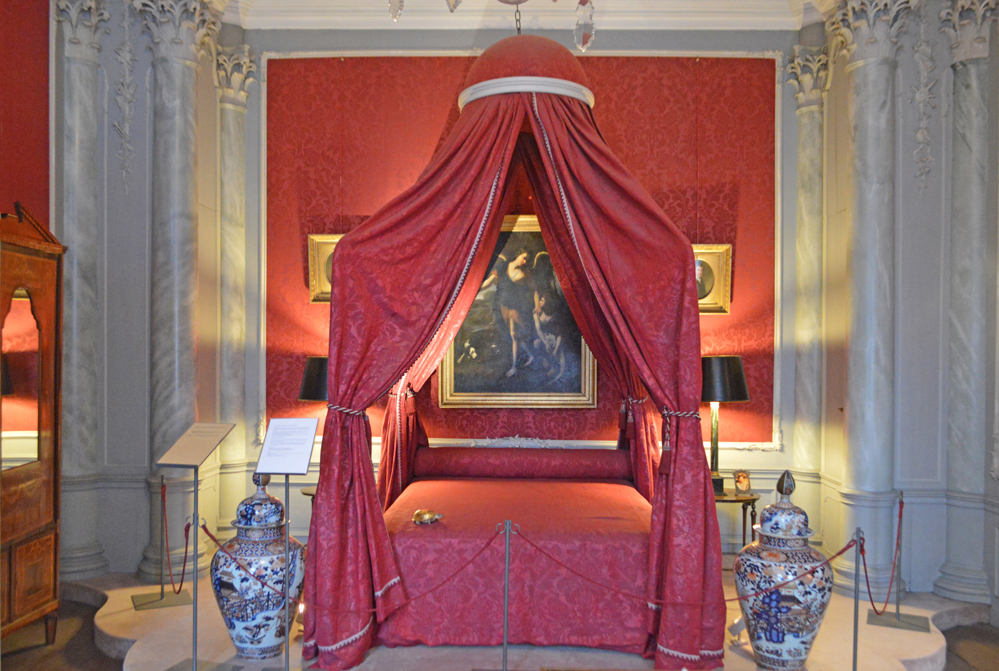
Despite being a Sèvres urn’s throw from London’s Oxford Street, The Wallace Collection at Hertford House always radiates an air of calm and civility. Perhaps it’s the sylvan setting of Manchester Square. Maybe it’s the muted acoustics of the Courtyard Restaurant. But most likely it is the dignity – even with some daring moments – of the interiors that secures this aura of being far from the madding crowd. The latest room in the former home of the Victorian collector Sir Richard Wallace to shine once more is the Great Gallery. It’s December 2014 and John O’Connell, Founder and Director of John J O’Connell Architects, is about to give a private tour of The Wallace Collection. The municipal museum is once more a sumptuous townhouse. Over to John:

“Sir Richard Wallace planned the internal spaces around the main staircase which has a balustrade from the Hôtel de Nevers in Paris. In principle, each room is enhanced to stress the domestic or private mansion aspect of the main house. For example interconnecting doors between rooms have been reinstated and indeed in the Study we have introduced an entirely new false door to visually balance the existing doorway on the other side of the fireplace. Our main purpose is to provide an augmented setting for the Collection. It is not about re-creating rooms as they were, no, but rather re-presenting them for today’s visitors and scholars. The colour of the Dining Garden Hall is a quieter silver grey. You can’t have hectic colours all the time! Curtains should cascade and be three dimensional: they should come forwards and backwards.”

“This is the size of a city block, the Great Gallery, so it’s an extraordinary beautiful room and what we’ve done is gone and looked at the archived photograph of the room as it was with this lovely laylight which had to be abolished at a certain moment and now with modern technology we can again have this great laylight. This is where you have studio glazing at the top of the roof and it in turn lets light down onto this magnificent daylight so in other words it has a huge amount of natural light falling into the room.”

“It’s not wallpaper on the walls. It’s the most wonderful possible fabric, silk, and it’s not just damask, it’s a brocatelle, so it’s got even more silk in it! I think that to, as it were, bring the gallery forward into the modern age, you need to get the best possible conditions: lighting, climate control, security, fire safety compliance, decorative effects, so you can bring all of that into this great space. You could only do that if you go right back and lift the roof off because that’s what happened here. You see, the entire roof of the Great Gallery was taken off and what we have here is a whole new room within the gallery space because this has the technology almost of a railway terminal, when you see the supporting structure, and yet inside it is so beautiful.”

“Architectural features must do at least three jobs. The oculi in the latticed cast plasterwork punch through the cove: vertical stop, start, stop, start, all the way round the room. They also let more light into the room and act as the return path for the air conditioning. Reinstating wainscoting has curatorial importance. The paintings come to life against coloured fabric above the dado rail and the light coloured wainscot is appropriate as a backdrop to furniture. The gilt fillet of the wainscot is more pronounced than in the preceding galleries. If it was too small it would look titchy; if it was too over the top it would look bonkers. The wainscot must flow along. The Great Gallery enshrines everything we have learned during our 19 years working at the Collection. Everything bar the floor is new.”

“I think first of all The Wallace Collection is so multifaceted, the armour, then of course furniture, particularly Boulle, as an architect we love Boulle furniture, this is what we really want! The great thing is here the parameters are set. You can move everything but you cannot acquire and you cannot dispose which is marvellous, so it’s like a game of chess all the time. Everything is of equal importance. The placement of objects is just so important.”

Earlier that year Country Life had featured the Great Gallery in its 10 September edition hailing the “triumphant revitalisation”. The hang has long been recognised as one of the world’s best displays of Old Masters. Only two of the principal galleries attached to aristocratic London townhouses survive: Apsley House in Piccadilly and Hertford House. But it was John’s work which really enthralled the magazine. Michael Hall writes in Gallery Tour: The Great Gallery at The Wallace Collection:

“The present restoration – which forms a climax, but not the conclusion, of a comprehensive programme of refurbishment of the galleries begun under The Wallace’s former Director Dame Rosalind Savill in 2000 – has been paid for by a single donation of £5 million by the Monument Trust, in memory of the Honourable Simon Sainsbury, a major donor to The Wallace and a former Trustee. As with the other galleries, the design work has been carried out by John O’Connell Architects.”

“At first glance, it may seem that nothing has changed, but, in fact, almost everything has. Even the gallery’s two doors, at the far ends of the south wall, are not in their original places. They were formerly close to the corners of the room, creating a dead space in the angle; now that they have been moved closer together, there is room to hang large pictures on either side of them. In the 1978 to 1982 restoration, the walls were hung with a coral coloured fabric, which, by 2012, had faded. It has been replaced by a small patterned crimson damask woven by Prelle in Lyon.”

“Inspired by the great Victorian private picture galleries of London – continuing a tradition that goes back to the 17th century – it provides a satisfyingly rich and deep toned backdrop to the paintings. The main seat furniture in the room, an early Louis XVI set of chairs and settees, has been reupholstered to match. One subtle but striking improvement is the addition of a chair rail and dado, which the room had never possessed before. This anchors the furniture to the setting, but, more significantly, provides a strong architectural base for the hang of the paintings, preventing any feeling that they are floating on these huge walls.”

“Most impressive of all is the coved ceiling. An entirely new design by John O’Connell, it reintroduces indirect sunlight by means of oval laylights in the cove and a large laylight in the centre of the room. This has been made possible by advances in air conditioning technology: the new system installed as part of the refurbishment is very much smaller than its 1978 to 1982 predecessor. Daylight brings the room alive, and lends sparkle to the paintings, enhanced by an entirely new lighting scheme – predominantly LEDs – by the engineers, Sutton Vane Associates.” Michael Hall describes the Great Gallery as “one of London’s greatest rooms”.

Ros was Director from 1992 to 2011. Her appointment was approved by Prime Minister John Major because The Wallace is a national museum. She had the dual task of creating the optimal 21st century museum visitor experience and meeting the expanded expectation of the Government. Ros breathed light and life into the museum, excavating the basement and glazing over the courtyard. Two temporary exhibition galleries, a theatre, a learning studio, a library, a meeting room and rows of individual bathrooms were inserted into the basement. The new spaces combine the practical with the scholarly. Most of all, Ros wanted the objects to sparkle and to bring a new domestic intimacy to the staterooms. And so she called upon John and together they embarked upon the golden age of transformation – at pace. Visitor numbers more than doubled.

At her Memorial Service in St Marylebone Anglican Church in May 2025, the Reverend Canon Dr Stephen Evans said, “Rosalind is not only renowned for her services to the study of ceramics, but also someone once described as ‘the most distinguished woman museum director of the western world’. Not only the keeper who transformed The Wallace Collection. A trusted advisor. A wise, exciting and imaginative teacher. An engaging meticulous writer whose public service was enlivened by ebullience, verve and passion.”

It’s August 2025: asparagus and feta mousse followed by orange and poppyseed cake are being served in the Courtyard Restaurant. A time for reflection in and on and about a monumental cultural legacy. The late great Dame Rosalind Savill was an inspirational scholar of European decorative arts, a visionary museum director, and a human being of such intelligence, empathy and grace. She called John “my genius architect”. His practice would later be responsible for redesigning major country house estates such as Montalto in County Down. What Ros and John achieved together at The Wallace Collection remains a touchstone of excellence for museums everywhere. Dancing to the music of time.

Categories
Architects Architecture Art Country Houses Design Luxury People

WOW!house 2025 + Design Centre Chelsea Harbour London

Always

It’s the perfect single storey neoclassical villa. And there’s just one month to experience it. “The façade draws on early Georgian architecture amplified in a Chelsea London context,” explains Darren Price, a Design Director at Adam Architecture. “Its refinement embraces contemporary minimalism and reinterprets the language of classicism in a way that feels both timeless and relevant to modern sensibilities. The neoclassical design relies on lines and arches rather than columns and pilasters.”

WOW!house is back in the Design Centre Chelsea Harbour for another year to inspire, educate and thrill. One of several new elements is a Town Garden designed by Alexander Hoyle and delivered by Artorius Faber. Stone materially links Adam Architecture’s façade and the garden: a Portland limestone plinth; reclaimed sandstone cobbles and walling; and reclaimed flagstones for the portico and arcades flooring. Walking through Darren’s portico, under the oculus in the Soaneian pendentive dome, over the corresponding tiled circle, leads into a procession of eight rooms, a Courtyard, 10 further rooms and onwards and outwards to a Grand Terrace. It’s like wandering through a stationary Venice Simplon-Orient Express with side carriages. International collaborations of interior designers, architects, design brands and suppliers stimulate the senses. Even smell: each room has its own dedicated Jo Malone London fragrance from Pomegranate Noir to Red Roses.

Victoria Davar of Maison Artefact perfectly captures a sense of arrival in the Entrance Hall sponsored by Cox London. A five metre ceiling height adds an extravagance of volume allowing for a floating staircase to spiral up towards an imaginary upper room. Victoria reckons, “We have designed a modern day cabinet of curiosities including a cast bronze and iron chandelier from Cox London.” A Robert Adam plaster frieze from Stevensons of Norwich draws on the neoclassicism of the façade. In contrast, Chad Dorsey’s members’ clubby Drawing Room, sponsored by Fromental, is Arts and Crafts. Fromental’s Kiku wallcovering wraps the room (and ceiling) in panels of stylised chrysanthemums and sunflowers. Chad continues the nature theme with Kyle Bunting’s chequerboard leather rug featuring birch and wheat emblems.

“The Phillip Jeffries Study is designed to be visually compelling but also should enhance the way someone lives and interacts with their environment,” suggests Staffan Tollgård. The Creative Director of Tollgård selected a striking abstract artwork formed of slices of oak and paulownia wood as a wallcovering by Phillip Jeffries. Another cosy space is the Nucleus Media Room designed by Alex Dauley. This Myrrh and Spice Jo Malone London aroma filled cocoon is swathed in Zinc Textile’s suede wallcovering and incorporates Nucleus’ seamless home automation.

“A space to intrigue, inspire and spark conversation,” is how Spinocchia Freund describes The Curator’s Room. The designer has a commitment to working exclusively with women. She collaborated with Ashley Stark, Creative Director of the room’s sponsor Stark, on a bespoke rug. Spinocchia explains, “This rug is a celebration of 87 powerful creative women such as Élisabeth Garouste, Zaha Hadid, Charlotte Perriand, Faye Toogood and Vanessa Raw. Their names are woven into it. My biggest issue was deciding who to include as there were so many suitable names!”

Tommaso Franchi of Tomèf Design collaborated with three of Italy’s leading heritage brands for the Primary Bedroom. Fabric house Fortuny, rattan furniture company Bonacina, and Venetian glass masters Barovier and Toso have all contributed pieces to a room embracing Italian craft. A Primary Bedroom that could be in Venice or Verona is not complete without some Murano: a Tomèf designed coffee table contains a collection of objets d’art made from offcuts of Barovier and Toso’s Murano glassware. Alisa Connery of 1508 London based the House of Rohle Primary Bathroom on reflection, ritual and reverie. The fluid shape of the freestanding bath and standalone shower by the room’s sponsor embodies the energy and movement of water.

Hurrah, Treasure House Fair has come early this year! Or at a least a foretaste has popped up. The Season fixture is Daniel Slowik’s Morning Room sponsor. The interior designer and antique dealer sourced furniture, paintings and objets d’art from contributors to the Treasure House Fair. Daniel’s imaginary client Richard Wallace. The 19th century art collector’s London home, Hertford House in Marylebone, is now The Wallace Collection. This museum and art gallery was reinvented by the brilliant symbiotic force of the late Director Dame Rosalind Savill and the neoclassical architect John O’Connell. A Bardiglio marble chimneypiece by Jamb provides a focal point for the Treasure House Morning Room. Set pieces include a George III pedimented bookcase from Ronald Philipps and a portrait by the 18th century artist Maria Verelst from Philip Mould.

The second of three (or is it four?) open spaces at WOW!house, the Perennials and Sutherland Courtyard designed by Goddard Littlefair combines the best of Andalusian gardens and Moorish architecture. Jo Littlefair compliments Perennials and Sutherland’s technological advancement, “Their outdoor Crescent furniture uses powder coated aluminium as a finish. It’s perfect in hotter climates because the coating has good thermal stability.” The Sims Hilditch Courtyard Room is firmly back on British soil. Country house specialist Emma Sims Hilditch has created a very smart behind the green baize door space. A coffered ceiling and antique furniture elevate this space from back of house to front of courtyard. A dog room and a boot room are set behind glazed internal partition walls in two corners of the Courtyard Room.

The perfect neoclassical villa must contain at least one fourposter bed and American Alessandra Branca comes up trumps with the Casa Branca Bedroom. Drawing on eclectic sources from David Hicks to Lee Radziwill, the sponsor and designer’s own brand of textiles, wallpapers and furniture fill the room. A border stripe framing curly motifs wallpaper is echoed in the striped bed curtains. Murano vases provide hints of Alessandra’s Italian heritage.

“It all began with a pair of taps,” reveals Samuel Heath, the exclusive bathware designer and manufacturer sponsoring the Bathroom by Laura Hammett. The stepped profile, chamfered corners and bronze finish of the new taps could belong to only one style of full bathroom design: Art Deco. “This year is the centenary of l’Exposition des Arts Décoratifs à Paris which launched Art Deco,” Laura relates. “We are really reimagining the 1920s style with gusto and have included a San Marino marble rolltop bath and matching double vanity unit.”

No world class display of interiors is complete without the Pre Raphaelite tour de force that is Kelly Hoppen CBE. Her moody Living Room, sponsored by Visual Comfort and Company, is all that is to be expected from the design powerhouse. She confirms, “Visual Comfort’s collection gave us the freedom to create atmosphere and rhythm through lighting.” Kelly has selected an earthy palette of rich brown, terracotta and muted neutrals. Vintage furniture sits cheek by jowl with bespoke pieces. She notes, “The Living Room blends asymmetry, history and personal storytelling.”

Curvature is a theme of the interiors and reaches a geometric climax in the Dedar Library by Pirajean Lees which is encircled by bookcases. Designers Clémence Pirajean and James Michael Lees discovered something they have in common with the cutting edge (no pun) fabric house of Dedar: a love of music. A440 Hz, the tuning standard of musical instruments before a concert, provides an unlikely source of inspiration for patterns in the painted dome ceiling and the rug made by Jennifer Manners. A pitch perfect room. The Argentinian writer Jorge Luis Borges imagined Paris as a library. And as the American journalist Maureen Callaghan warns, “If you ever go back with someone after a night out and they’ve no books in their home, run! Run!”

Drummonds backed Nicola Harding’s jewel box inspired Powder Room. The Art Deco style collection includes a marble top vanity and storage units reflected in antiqued mirrors in a glazed ceramic tiled setting. “For the Powder Room you have to be more dramatic,” Nicola opines. “It’s a space where you’re likely to be alone so it can be an escape. We wanted to create an intoxicating atmosphere rich with colour and texture.” The colourway includes ruby, turquoise and jade. In contrast, Toni Black of Blacksheep uses a palette of soft blush, terracotta and taupe for her Home Bar. The scheme is centred on Shepel’s handmade joinery and furniture. A curvaceous bar follows the rounded rectangle room shape.

“The application and finish of the paint is paramount to the finished look and feel of any room, so we’re thrilled to work with Benjamin Moore, the best paint brand out there,” exclaims Peter Mikic, the designer of the Dining Room. A vast abstract artwork by Billy Metcalfe and trompe l’oeil panels by Ian Harper – using Benjamin Moore paint of course – provide sweeps of colour across the walls. Vintage Lucite leopard skin fabric metal framed dining chairs contrast with a circular dining table bejewelled with semi precious stones made by Kaizen.

Atmospheric lighting is another theme of this villa so who better than Hector Finch to sponsor the Thurstan Snug? “We were inspired by Hector’s enthusiasm for designing and crafting his lighting,” says the room’s designer James Thurston Waterworth, Founder of interiors practice Thurstan. “So we imagined a practical creative space where he could draft sketches, test samples and immerse himself in books.” Blue lime plaster walls painted with marble dust bound by varnish and a d’Ardeche parquet floor bring rich patinas to the Snug.

Ben Pentreath Studio is one of King Charles’ favourite architectural design companies. The Studio’s Rupert Cunningham, Leo Kary and Alice Montgomery have come up with the Kitchen built by Lopen Joinery which would definitely persuade Queen Camilla to don her cooking apron. Grecogothik is a novel portmanteau the team jokingly use to describe the genre of this unfitted room. Octagonal shaped cabinet legs reflect the shape of the octagonal rooflight. Art should be in every room in the house and paintings in the Kitchen include Tallisker Isle of Sky bye by John Nash (Paul Nash’s younger brother, not the architect).

His Majesty would certainly enjoy the Garden Terrace designed by Randle Siddeley which leads off the Kitchen. This exotic garden under the glass sky of the Design Centre Chelsea Harbour is filled with lush planting and framed by formal trellis in the style of an orangery. Randle believes, “The Garden Terrace is an immersive escape where one can pause, entertain and connect with nature.” Bespoke aluminium outdoor furniture by the space sponsor McKinnon and Harris includes scalloped dining chairs and an Italianate table. Mental note: every space deserves a crystal chandelier. Things get really wild … in the same collaborators’ Secret Garden filled with Oxenwood outdoor furniture.

This year, WOW!House truly is La Nouvelle Exposition des Arts Décoratifs de Londres. WOW!House 2025 deserves its own chapter in the sequel to Peter Thornton’s 1984 authoritative tome Authentic Décor The Domestic Interior 1620 to 1920.

Categories
Architecture Art Country Houses Design Developers Fashion Hotels Luxury People Restaurants Town Houses

Lavender’s Blue + 1,000 Articles

Upward We Fly

The Tuamgraney born London based novelist Edna O’Brien once remarked, “There’s a very interesting thing about memory and exile. It is only when you leave someone or something that the full power if you like, the performance of it is in you, it’s inside you. So separation brings the emotions and ultimately a book. I think a book is the accumulation of emotions written in a particular, hopefully musical, way. It’s a beautiful feeling actually; it’s like the whole influx of something that is stronger than memory. Of course, it’s memory but you’re back in it, not writing it secondhand. Again, that counts for a certain derangement.”

It all started with Cliveden. In September 2012, we received an invitation to stay in the Berkshire hotel but as hard copy publications back then were disappearing faster than Veuve Cliquot at one of our soirées, we came up with the idea of publishing an article online. And so Lavender’s Blue was born. The name has triple derivation after our home (“Your house is so cinematic!” declares film director Stephan Pierre Mitchell), our location and the song by Marillion. Before long, every PR in London and further afield learned we always turn up, give good party, and even better copy. Although five parties in one day starting with an 11am Champagne reception for New York thinker John Mack in the Rosewood Hotel was pushing it even by our standards. Actually, it all really began in April 1995 with a column House of the Month in Ulster Architect magazine, edited and published by the bold and brave and brilliant Anne Davey Orr. But that’s a whole other story.

While most events are one-offs, from a vanishing crystal coach at Ascot to a vanishing guest on the Orient Express, others would become annual events. If the preview of Masterpiece (in Royal Hospital Chelsea grounds) was an early summer hit each year, the Boutique Hotel Awards (in Merchant Taylor’s Hall) would quickly become a midwinter highlight. Fortunately Masterpiece has been replaced by The Treasure House Fair and WOW!house and we’ve landed ourselves on their preview lists. We’re also proving a hit at the annual International Media Marketplace.

Behind the curtain. That’s our forte. And we don’t just mean peeping round the iron variety (think Gdańsk). We’re not only through the gates: we’re over the threshold. We gain access where others dare not tread. If it’s an Irish country house, we’ll stay with the owners and explore the cellars and attics – preferably when they’re tucked up in their fourposter (Temple House). We’ll pop into the kitchen to see what’s really going on whether in Le Bristol or Comme Chez Soi. We’ll talk to the lady of the manor and a millworker (Sion Mills). Sometimes it takes a village to raise an article: in Castletownshend the fun began over breakfast at The Castle continuing through public houses and private houses up Main Street before ending back in The Castle by dawn.

If “design” is the mauve thread that sews Lavender’s Blue together, “celebration of life” is our way of banishing anything mentally blue. Illuminated by art and architecture, fashion and the Divine, we’re mad for life, channelling that literary derangement. But if it ain’t good, it don’t appear. Simple. At the opposite end of the spectrum, some events are far too private to be published such as an impresario salon recital in one of London’s grandest houses surrounded by more Zoffanys than The National Gallery owns while sampling the owners’ South African wine cellar. Or a party in Corke Lodge, County Wicklow, with more diplomats per square metre than Kensington Palace Gardens being serenaded by the Whiffenpoofs on the folly gladed lawn.

Lavender’s Blue is all about places and people so we rarely do personal. You won’t read how we were catastrophically frogmarched out of The Lanesborough (too much catwalking) or categorically told to pipe down in Launceston Place (too much caterwauling). Or the full story of hijinks with the model Parees which one friend described as sounding like an escapade from an Armistead Maupin short story. Original writing and original photography – and occasionally original drawing (from a two minute sketch of Mountainstown House to a 10 hour floor plan of Derrymore House) – are our creative cornerstones. We never plagiarise except from ourselves: to quote from one of our most read articles, Beaulieu House, “Lavender’s Blue is the brilliant coated edition of universal facts, riveting mankind, bringing nice and pretty events.” We’ll coin the odd phrase too from “Absinthe makes the heart grow fonder” to “You can’t be this fabulous and not make a few enemies!”

What’s our literary style? Well we’re not paid up members of Plain English for starters. Lord Wolfe would blanche at such opening gambits as, “There’s nothing standard in The Standard” or “Mary Martin London fashion is more than an antinomic macédoine: it is a semiotic embrace of science and conviction made manifest in materiality, tactility and sartorial disruption”. There are a quarter of a million English words to choose from (compared to a mere 100,000 in French and a meagre 85,000 in Chinese) so why reach for simplicity when you can stretch the lexicon? We don’t like to namedrop but as Daphne Guinness shared with us about her lyrics at a party in Notting Hill, “There are some words I just really like the sound of!” A picture tells 1,000 words and sometimes we’ll deliver 1,000 words and 1,000 pictures. But how can you keep the shutter open when you’re cherishing Chatsworth or roaming round Rochester? We’re not just about obvious glitz and glamour. So we frequent Hôtel Meurice in Paris and Hôtel Meurice in Calais. We’ve explored Georgian Bath and Georgian Dover. Doubling down on clichés is avoided except in derision while downing Chapel Down south of the Kent Downs.

How long does an article take to prepare? Some flow with automatic writing on a commute or in bed or in the bath in almost unconscious reverie. Others take decades. Mourne Park House started with a memorable visit in 1992 (the boathouse collapsed and gracefully slid into the lake mid morning coffee) and continued with return visits up to 2021 (by then the house was badly burnt). Crevenagh House was photographed over two decades in every season from heavy snow to scorching sunshine. We visited Gunnersbury Park four times over a London heatwave to capture it morning, noon, evening, and after supper. We also vacationed at Murlough four times, Irish Sea hopping in search of elusive sunlight. Montevetro and Marlfield both first appeared in Ulster Architect before being resurrected on Lavender’s Blue. Marlfield is the work of genius architect Alfred Cochrane with later lodges by the talented Albert Noonan. And on that note, John O’Connell’s work (Montalto) and tours (Ranger’s House) have added an abundance of sparkle to Lavender’s Blue.

We’re always up for top drawer collaborations: polo in Buenos Aires; the Government in Montenegro; Audi in Istanbul; Boutique Hotels Club in Bruges; Guggenheim in Bilbao; Rare Champagne in Paris. Did we mention Paris? The friendliest city in the world! As long as you’re in the right set, of course. We know our French, spring, red and rings. Oh, and we’re easily dragooned to fashion shows stretching the bailiwick especially when it comes to fashion artist Mary Martin London. Vintage models (Goodwood, Carmen dell’Orefice and Pattie Boyd), modern models (Esther Blakley, Janice Blakley and Katie Ice – all beautiful, all gazelles), royalty (Queen Ronke and Catherine Princess of Wales) and pop star royalty (Heather Small) have all enjoyed Lavender’s Blue exposure. There are even occasional segues into filming (Newzroom Afrika and English Heritage) and the dreaded bashing of ivories (Rabbit).

The current culmination of Lavender’s Blue is an exquisitely printed hardback coffee table book of substance on the Holy Land. The first edition of SABBATH PLUS ONE was an instant sellout at Daunt Books Marylebone. It’s now on the coffee tables of all the best homes – including a certain Clarence House. Oh yes, King Charles III is really enjoying his copy. “Your most thoughtful gesture is greatly appreciated …” So it’s time for the second edition. Same high quality print with a reddish burgundy rather than navy blue hard back hand stitched fabric cover. We’re still gonna vaunt about Daunt. Only the finest. In all the best libraries now, not least earning its stripes at Abbey Leix House and Pitchford Hall. And lobbies: The American Colony Hotel and The Jaffa.

We do love our triple Michelin starred places (L’Ambroisie, Lasarte, Core). Champagne! Foam! Truffle! While most of the restaurants we have visited are still thriving, unknowingly at the time, Lavender’s Blue would become an archive for quite a few. Aquavit, Bank Westminster and Zander Bar, Duddell’s, Farmacy, Galvin at Windows in The Hilton Park Lane, The Gas Station (one of our regular rendezvous with fellow gourmand Becks), Hello Darling, Marcus Wareing’s Tredwell’s, 8 Mount Street, Nuala, Plateau, Rex Whistler at Tate Britain, San Lorenzo, Senkai, Tom Kemble at Bonham’s, and Typing Room all in London have disappeared. So have Scheltema in Brussels, Le Détroit in Calais, The Black Douglas in Deal, The Table in Broadstairs, l’Écrivain in Dublin, Cristal Room Baccarat in Paris, and Forage and Folk in Omagh.

Still, nothing tastes as good as skinny fries. It’s survival of the fattest! Impressive as it was, Embassy Gardens Marketing Suite was never built to last. Erarta Art Gallery, Fu Manchu nightclub (the real Annabel’s!) and The Green and Found gift shop are lost in the mists of time. We’d barely photographed Quinlan Terry’s 35 year old junior common room bungalow at Downing College before the wrecker’s ball entered the site. We’re already missing our perfumer neighbour Sniff.

Even sadder, we have become the repository for final curtain interviews. Min Hogg, Founding Editor of The World of Interiors magazine and Anna Wintour’s first boss, the 9th Marquess of Waterford and the musician Diana Rogers entertained us – and hopefully you – with their end of life witticisms. David George, a reader of our Diana in Savannah article wrote, “I was married to her for 10 years and we were together for more than two decades. When you look in the sky she is the brightest star that you will ever see! I love you sweet middle class princess! Rest in peace, all my love, David.” We featured artist Trevor Newton’s final solo show and fashion designer Thierry Mugler taking his au revoir bow at the Musée des Arts Décoratifs Paris. Now historic photographs of model Misty Bailey appeared on Lavender’s Blue. Lindy Guinness, the last Marchioness of Dufferin and Ava, shared thoughts at one of her last townhouse parties full of people one should know like the international tastemaker Charles Plante. Beresford Neill reminisced on early 20th century Tyrella. And of course, two memorial pieces to the much missed Dorinda, Lady Dunleath. The last book launch of Dame Rosalind Savill, the inspirational scholar of European decorative arts and visionary museum director of the Wallace Collection, is another moving memory now frozen in time.

Readers’ comments are always of interest. Standout messages include a painting request to Ballyfin; advice on the best photographic viewing point at Dungiven Castle; revealing a shared love of Mary Delany or the Mitfords; a discussion of the meaning of Rue Monsieur; Samarès Manor relatives trying to contact each other during a Jersey storm; and an unreported baby drowning in a mansion swimming pool in Sandwich Bay. Mount Congreve attracted interesting comments including from James Sweeney who wrote, “I worked in Mount Congreve Estate for many years as a Private Chef to the Congreves. It was a joy and a pleasure and has given me cherished memories. Mr Congreve was an amazing man and I owe him a great deal for his wisdom that he kindly let me benefit from.”

Ewelina from Beauty on the Cliff poetically scribed, “Waterford is my home since 17 years and Mount Congreve was always my soft point. The moment when you enter the place is simply magical. I’ve been inside the house recently, just before yesterday. I was inside of the Blue Wedgwood Room … well … only the pale blue walls and the beautiful but sadly empty china cabinets reminded me about past grandeur of this place. It’s really really heartbreaking to see the empty rooms, stripped from everything … even the curtains … the books all over the floor in the library … totally without the respect for Mr Congreve. I hope that Waterford City Council didn’t forget that was someone else’s home. As Mr Yeats said, ‘Tread softly because you tread on my dreams.’ Thank you so much for your review. Kindest regards from Waterford.” Sara Stainsby messaged, “Really interesting essay on Stapleford Park. My great grandparents worked there, my grandmother was born there and was married in the church. In the 70s I visited my great grandparents when they lived in a flat above the stables …” Birthday wishes (Portrait) and restoration concerns (Barden Towers) are always welcome. Even more welcome was a Champers accompanied poem hand delivered to the state dining room (Hartwell House).

There are direct messages too: “I came across your Lavender’s Blue series starting from Auchinleck then Crevenagh House and Tullan Strand. I can see from your McClelland connection that you have an interest in Northern Ireland including Donegal … I found that your articles on architecture address the most erudite, meticulous and expansive aspects of the subject so perhaps the work of James Taylor in late Georgian times will fall beneath the range of your interest in the style and proportions of symmetrical Palladian buildings.” We jumped straight in a car to Islington. Likewise when tipped off about Stockwell Park. A reader enjoyed our “wonderful commentary on various aspects of Ballyshannon … tis wonderful to share your thoughts about my hometown”. We’ll accept high praise from Ireland’s greatest host: “I just love your articles striking notes of deepest erudizione to soprano and coloratura gossip! I’m so glad you were the catalyst to my party and I can’t believe it went so well.”

Amazing Grace Point inspired a declaration of faith: “Lough Swilly and Fort Dunree is one of the most wonderful places in Ireland to visit, and especially to look out across the waters where so many great ships have sailed. But most of all – to ponder the words of Amazing Grace written there by John Newton. His miraculous conversion credited to his mother’s prayers. She never gave up, like my mother, who never gave up but prayed me into the Kingdom.” Messages come from above and down under: “I hope you don’t mind me emailing you but I happened to walk into a beautiful graveyard today in Picton, Australia, and happened to come across this one particular headstone. I was instantly intrigued as my grandparents were from Donegal in Ireland and I wanted to see if this was close? Anyway I just read about Mountjoy Square and when the area become established. I’m not sure but working out the dates I think this couple might have been some of the original inhabitants? I saw an article that you wrote and just wanted to share this with you – you may or may not appreciate it but I wanted to bring this couple home!” They’ve come home.

Artist and art restorer Denise Cook crosses the rare divide from comment provider to content provider sharing her expanse of knowledge from Pink Magnolias to the Rector of Stiffkey. So does Dr Roderick O’Donnell, world authority on all matters Pugin. Another reader turned writer, the ever erudite historian and patron of the arts Nicholas Sheaff, brought Gosford Castle completely (back) to life. “There is really too much to say,” to parrot Henry James in The Portrait of a Lady, 1881. Haud muto factum.

As Reverend Prebendary Andy Rider once quipped, “You do get around.” Amsterdam to Zürich, Brussels to Verona, Channel Island hopping, nowhere is safe from the Lavender’s Blue sagacity filled patrician treatment. As for our favourite place, that’s simple: Bunbeg Beach, especially at 10.30pm on a sun drenched midsummer night. Chronicling our times, we produce the material – and sometimes we are the material. But only when shot by the likes of top cinematographer Mina Hanbury-Tennyson-Choi and shoot the shoot supremo Simon Dutson. Striking a striking pose. Fading grandeur (the interior not the model).

“The whole earth is filled with awe at Your wonders; where morning dawns, where evening fades, You call forth songs of joy,” Psalm 65. Lavender’s Blue is between the bookends of everything that was and is to come. It’s about dealing with things as they are, not as they should be. We’re all about orchestrating a fresh approach, synthesising Baroque stridency with Palladian refinement. Our oeuvre is a sumptuous sequence of artistic compositions. On the frontline, turning to face the light. Mary Oliver always gets it right: Instructions for Living a Life, 2010, “Pay attention. Be astonished. Tell about it.” Thank you to all our readers. Thank you Council Bluffs. In the short now, to pluralise the words of the French Resistance fighter Simone Segouin, “We’d do it all again.”

Categories
Architects Architecture Developers People Town Houses

North Great George’s Street Dublin +

Say More Things

Dublin is so rich in neoclassical Georgian architecture, overblown and exuberant in its ‘costly magnificence’. The American Federal style was also inspired by the richness of the Irish interior architecture and the boldness of its 18th century furniture. Many fine examples can be found on the East Coast from Boston to Philadelphia.” American art collector and international tastemaker Charles Plante lives and works on either side of the Atlantic.

North Great George’s Street, north of the River Liffey in Dublin, is all about overblown scale architecture and exuberant interior plasterwork. And the owners of the houses would agree it costs a lot to look this magnificent. Since the 1970s, this street has boasted a remarkable group of owners, not least Ireland’s foremost heritage architect John O’Connell. Former Chairman of the Irish bookshop chain Eason and conservationist Harold Clarke lived on the street from the 1960s until the 1980s. The distinguished antiques dealer Willie Dillon was his neighbour at that time.

Thomas McKeown, Chairman of The North Great George’s Street Preservation Society, lives on the street with his wife Adelaide. “In 1767 Sarah Archdall began selling sites to individuals who wanted to build houses on what was then the Mount Eccles Estate. Building started shortly afterwards and North Great George’s Street was essentially completed by about 1800. Then came the Act of Union in 1801 and the relocation of the centre of fashion to the proximity of Leinster House marked the beginning of a slow decline. Indeed, by the early 1900s a group calling themselves the ‘Georgian Society’ was formed to make a historic record of the fine buildings that were apparently already doomed to destruction. This was prophetic and many of the buildings that are documented in their work have long since disappeared.”

“By the beginning of the 20th century a large part of the street was already in multi family tenements and by the mid 1960s some of the houses had been demolished. At this time there was also an increased awareness of the inherent value of our Georgian heritage. On North Great George’s Street, fine houses, needing major restoration, were available for the price of a suburban semi detached. This was recognised by a number of starry eyed individuals who saw the chance to live in a great house – this prize came at the price of much effort, often in the face of official indifference.”

“The result – appreciated by more and more people – is there to see and would probably not have succeeded if a group had not joined forces to form The North Great George’s Street Preservation Society. One of our main objectives has been to have the street designated an Architectural Conservation Area by Dublin City Council. This would prevent excessive development, particularly of the mews lanes. The reinstatement of damaged pavements and the removal of utility wires and cables on the façades is another.”

“The houses on the street are not going to revert to single family homes any time soon, but hopefully there will be a mix of good quality apartments with a limited commercial element that will maintain the vibrancy that has made it the best place in the city centre to live. The Society will continue to strive to attain these objectives and above all preserve the integrity of the street’s great architecture.”

Senator David Norris, renowned James Joyce authority, bought his house in 1978. “What initially attracted me to purchasing a Georgian house was the sense of space and the way in which light poured in through the great windows. I adore the 18th century plasterwork which decorates some of the ceilings. On top of all this, North Great George’s Street is smack bang in the middle of the city. Along the way I suppose the greatest challenge has been finance. In the beginning none of us had any great deal of money and that is when the Society proved a great support. The other thing was finding appropriate craftsmen who were capable of dealing with an 18th century building.”

Architect John Hanley and sculptor John Aboud bought their house in 1987. “Over the next 30 years we gradually turned the house around. We have always enjoyed living here, even in the early years when winter gales would sweep through the rooms. The space and the light, together with the decorative details and the views to the garden, are a constant source of pleasure. The street itself, rising in stately terraces towards Belvedere House, is a magnificent backdrop to our everyday life. And of equal importance is the fact that here we have a close knit village in the midst of the city, where we are surrounded by neighbours and friends who share our pleasure in living here, and our commitment to its future.” The North Great George’s Street Preservation Society celebrated its 40th anniversary in 2019.

Categories
Architecture Country Houses Developers Hotels Luxury People Restaurants

The Carriage Rooms + Montalto Ballynahinch Down

Building It Up

Developed by an early whim of nature, Montalto is imagined to mean ‘high hill’. A sloping driveway rises past brick huts, a hazily remembered transition of the estate’s occupation by American soldiers during the Second World War. A breath of golden haze hovers idly above the sweep of lawns and lake and gardens. Here and there clusters of oaks form delicate groves of shade.

Ahead, beyond a car park sensitively planted with semi-mature trees, are The Carriage Rooms, a complete, quite perfect thing of beauty, flowing in an even line. This new-born riot of dreams evolved from the keen minds of the clients, Gordon and June Wilson, and the confident logical voice of the architect, John O’Connell. It all began with the 1850s mill, special in a building of special events. Three of the Wilsons’ offspring held their weddings in its unconverted splendour. An idea was born.

Once it was a one stop shop serving the 11,000 hectare Montalto estate and adjacent town of Ballynahinch. A saw workshop occupied the undercroft with a threshing mill overhead. Now it is a one stop shop for wedding ceremonies, suppers and dancing. The beauty of things, lights and shadows, motions and faces, provide quick sensory impressions against the tapestry of charcoal grey cut stone and burnt red brick walls.

Like Montalto House itself, the semi basement level of the mill was excavated during conversion to increase penetration of natural light into the interior. As a result, the front arched window overlooks the chiselled wonder of rocks. “That view acts as a reminder to bridal parties that marriage should be built upon rock solid foundations!” jests David Anderson OBE, manager of Montalto House. A wall has been constructed behind the outcrop to prevent glimmering parallels of light from vehicles in the car park roaring across the room.

Brick piers and beams conceal air vents in the main space. To one side, a vaulted passageway leads to the crisp darkness of the plant room. The air vent above this streaked artery is exposed to create a more contemporary look. On the other side, a little vaulted bar is lit by a trio of lunette windows. The gradual gradient of a disabled access ramp doubles as a standing area. Candle niches are carved out of the walls.

“Everything is right, purposeful and has a practical use,” remarks David. “It’s all about delivery of the product. Storage is cleverly incorporated throughout to allow events to flow unhindered.” He confirms The Carriage Rooms are not just for weddings but are also aimed at the conference and performing and visual arts markets. “It’s all about creating an elegant lifestyle,” David adds. “We’re offering a very high end pre-finished product, right down to carefully chosen silver and glassware.”

He continues, “Quality at every angle is what sets us apart. We have a tried, tested and trusted relationship with our recommended catering partner Yellow Door.” Guests can stay over in the gorgeous quarters of Montalto House, the former residence of the Wilsons. Their market research included jaunts to other top notch locations like Ballywalter Park, Belle Isle and Crom Castle. Grandson of Fred, the great FG Wilson, managing director David Wilson’s accountancy skills and venue manager Keith Reilly’s organisational acumen add to the equation equalling success. The Carriage Rooms have become a race apart. There are no plurals.

Attached to the former mill is a smart new two storey rendered block portraying a pleasing preponderance of wall over window. A glazed door opens noiselessly into the magnificence of the entrance hall. Fresh and vigorous, this hall derives its resonance from its very articulateness. The yellow glow and blue shadows of an open fire flicker across its symmetrical features.

The conference room links the entrance hall to the 1850s building. It is a radiantly imagined intervening parlour of politeness. The ceiling is formed of rows of brick and tile vaults. “You won’t find wall to wall Colefax and Fowler here!” jokes David. Instead is a robustly rural neoclassicism – brick cornices, carriage lamps, steel capped beams and granite fireplaces surrounding chamfered cast iron insets – perfecting a brilliant, permeating symbolism.

The double height staircase hall adjoins the entrance hall. Cantilevered granite flights of stairs climb in radiance, overlooked by the translucent feminine languor of upper level Juliet balconies. Accessed off the staircase hall is a discretely placed lift lobby.

The threshing mill is now the banqueting hall: somewhere to lunch on trout, avocado and a pint of Californian wine. “It has a great view from every window,” observes David. Several of the brick arches were reopened, the barn doors downgraded to shutters. The difference in levels becomes apparent in this room which is first floor to the front but opens onto the stable yard at ground level to the side. An arrangement of interior lights at the top makes a sort of floating fairyland. Under the high ceilings the situation seems so dignified.

Lunching together en masses, warmed with liquor as the afternoon begins, floats airy, inconsequential chatter and high-pitched laughter, above all the banqueting hall is another reminder of John’s love of the symmetric. Short hallways on either side of the ground level elevation lead to neat single bay single storey singular pavilions of projecting perpendicularity. One links to the kitchens; the other to the bride’s bathroom.

Symmetry, harmony and balance reach an apex on a central axis in the brick faced orangery where indoors meets outdoors. Below the parapet, pairs of French doors surmounted by fanlights fragmented by umbrella spike glazing bars open gracefully onto a terrace. The wealthy, happy sun glitters in transient gold through the thick windows of this magical, breathless room. A curious lightness permeates the rarefied air. This is a room where the solid, soft gold of the walls yields to the greenery of the exterior. It dazzles the eyes. “This is The Carriage Rooms’ architecture at its most formal,” notes David.Beyond lies the walled garden, fragrant with a host of flowers, a place for promenaders on a protracted circuit to digest sandwiches and sundaes eaten for lunch. The troubles of the day can arrange themselves in trim formation in this civilised setting. Annexed off it, crowded with planets and nebulance of cigarettes, is the smoking area, half enclosed by a symmetrical sweep of fencing. A narrow path that winds like a garter round the building descends towards the entrance front for a few more gorgeous moments.

Subtle and intricate, The Carriage Rooms exude a confident charm. A white radiance is kindled that glows upon the air like a fragment of the morning star. It is a place for débutantes, rakes and filles de joie to accept the wealth of high finance and high extravagance. The Carriage Rooms are a venue to deliver extreme happiness in the awakening of flowing souls.

Categories
Art Design Developers People Town Houses

Keizersgracht + Museum van Loon Amsterdam

Double Dutch

A myriad of canals provides Amsterdam with such a quantity of mirrors that narcissism becomes inevitable. Reflected every moment by thousands of square metres of rippling silver amalgam, it’s as if the city is constantly being filmed by its water. Consequently each canalside building lends the impression of existing as an egotist solely preoccupied by its appearance. And each canal’s own vanity is to reflect the lights dangling under the bridge arches. They, in turn, appear as shimmering pearl necklaces.

Last winter, a heavy veil of snow hung over the city. Along Keizersgracht, one of the three original canals, cars morphed into white mounds and overhead wires dripped with crystals of ice. Snow on snow on snow. Assuming you’ve recycled your Moët & Chandon bottles at De Appel Arts Centre, tackled the Rijksmuseum, skipped the queue at the Stedelijk Extension and ruminated at the Van Gogh, something of altogether more domestic proportions yet distilling elements of all three is 672 Keizersgracht. Enter Museum van Loon.

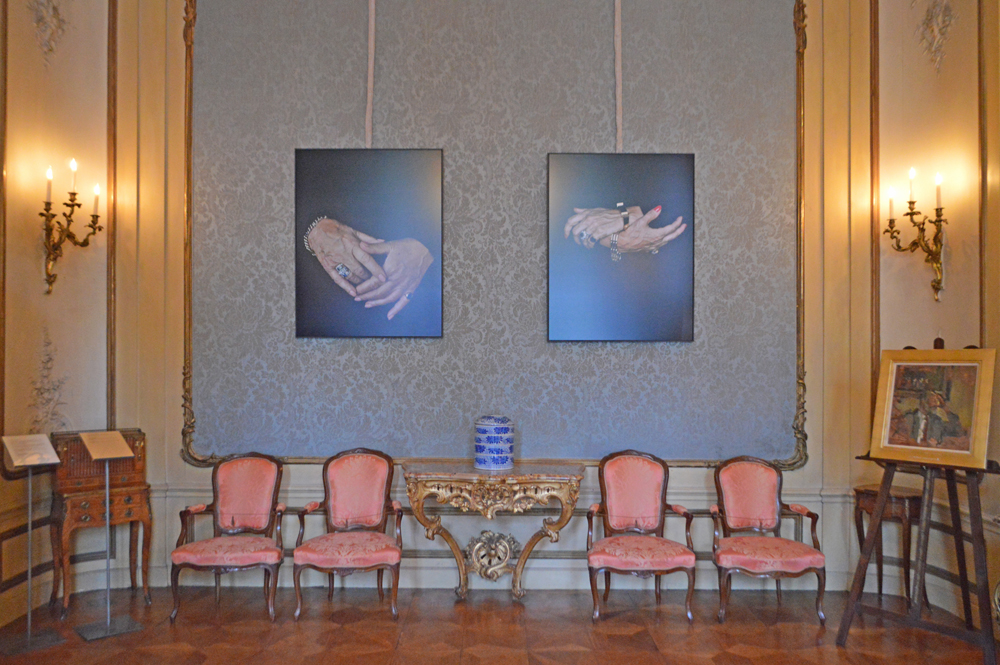
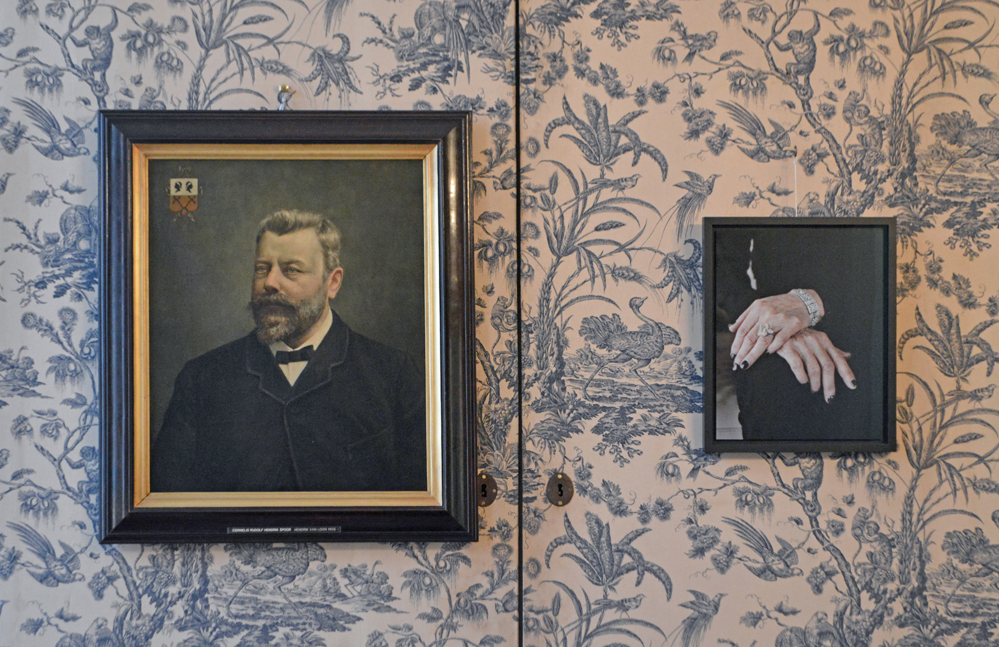
Furniture fans will get a Louis the Hooey eyeful; antiques lovers can ogle at porcelain collections spanning three centuries; while integrated contemporary art featuring the likes of light boxes by Danielle van Ark and photographs of Juliette Lewis add an experimental twist to the mix.

“The van Loon family has frozen the house exactly as it was when it opened in 1973,” announces the surprisingly youthful Museum Director and Curator, Tonko Grever. Well that puts paid to any John Fowler type debate over which period should take prominence. “As a result priceless pieces sit next to modern miscellanea. It’s still considered unusual in Amsterdam to open your house to the public,” reveals Tonko. “Maurits van Loon was the last surviving male of the family.” He died in 2005 aged 83. The first van Loons to live here were Willem and his wife Thora. His ancestor, another Willem, was one of the founders of the Dutch East India Company.

“The former butler’s son called by the house a while back,” says Tonko. “He couldn’t believe Mr van Loon just lived in an apartment on the top two floors. I reminded him that a private pad in this part of town, away from the neon nightmare that is Damrak, is still quite a status symbol! Plus it’s pretty big by modern standards.” A handful of staff runs the house now in place of 10 to 15 servants.

Narrow dizzyingly steep vertigo inducing stairs are an all too common feature of Amsterdam houses. Not here. Dr Abraham van Hagen, newly married to the metaphorically monikered Catharina Trip, an American heiress, proved he’d a flair for fabulousness when he redecorated the house in 1752 with enviable élan. Under van Hagen’s  watchful eye, the visual candy men of the day let rip on the interiors. V HAGEN is worked into the first flight of brass and iron balustrades in the spacious staircase hall and TRIP (no puns please) on the second flight. “Museum van Loon is essentially the bones of a 17th century house dressed up in 18th century gear,” Tonko comments.

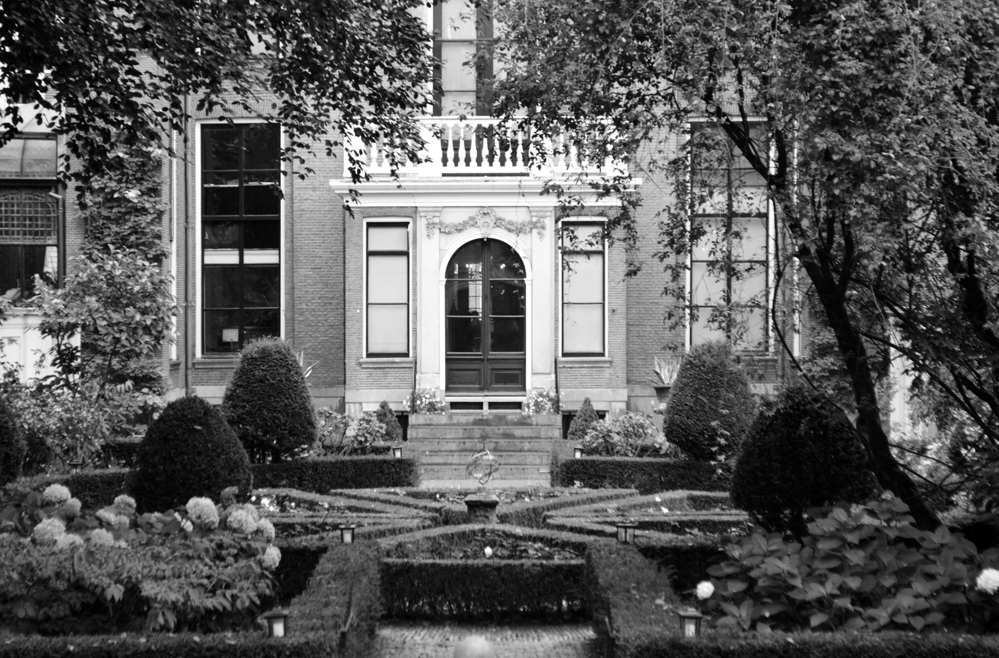
The house was built in 1672 as one of a pair of symmetrical properties. Rows of windows mirror the canal through a glass darkly across a ‘flat style’ façade. The straight entablatures and cornices of this austere branch of neoclassicism replaced the jaunty twists and turns of Dutch gables from the late 18th century onwards. The architect was Adriaan Dortsman, the John O’Connell of his day; the client, a Flemish merchant named Jeremiah van Raey; the first tenant, Rembrant’s sidekick Ferdinand Bol. “The houses occupy four plots. But Dortsman struck a deal with the authorities and got four for the price of three,” relates Tonko.

A formal garden, entered via the French doors of the garden room, is an oasis of calm away from the busy bustle of the city. It was designed by Eugénie André in 1998 who was inspired by the geometric plan drawn by Jacobus Bosch on his 1679 map of Keizersgracht. When Lavender’s Blue were there, the garden was wrapped in a thick blanket of snow. Shrubs were transmogrified into white blobs and snow on snow lay heavy on the carriage house roof. Tonko notes, “It’s a different picture in summer. The garden is used as a venue for intimate opera concerts. Last June, it was one of 25 canal gardens open to the public as part of the City on the Water tourism drive.”

During renovations the foundations were underpinned with 64 new pilings. “This provided an ideal opportunity to drop the floor level of the kitchen by 20 centimetres because the basement levels were so low,” explains Tonko. Even so, they still are. “The room was then reconstructed using photos from an old servant’s album. One photo from around 1900 shows Leida the cook’s cat perched on a bench. It’s funny – the kitchen was placed at the opposite end of the house from the raised ground floor dining room. Impractical or what?”

On the first floor, surprisingly (the house is deeper than it’s wide), there are only four bedrooms. “Maurits van Loon recalled screens dividing up the bedrooms for privacy. The children had to share rooms with their siblings,” Tonko tells us. “My favourite room is the Sheep Room. You’d have no problem falling asleep there. Just count the sheep!” He’s referring to the strikingly patterned wallpaper which depicts sheep running amok amidst foliage and flowers. It was printed in Nîmes on 18th century woodblocks. Tiny square projections accommodating powder rooms flank the rear elevation.

An ostentatious Polonaise bed – the Regency type that left behind the clean lines of Georgian sobriety and tipsily headed down the helter skelter of Victorian floridity – dominates the Master Bedroom. “When the house is closed to the public, Maurits van Loon and his guests used to stay in the state rooms. Look!” points Tonko. “To the left of the bed is a modern phone. But the formality of the past is present too. A fake door next to the real bedroom door contains extra panels to align it with the fireplace.” Actually there are jib doors galore in the house concealing a rabbit warren of bookshelves, cupboards and even a staircase.

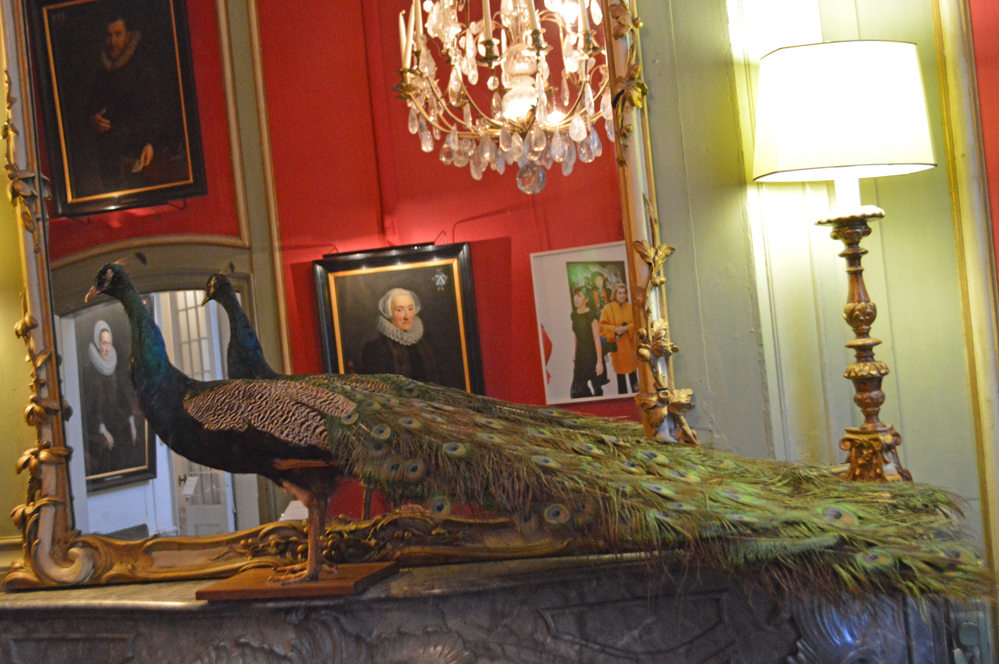
Lila Acheson Wallace, co founder of Reader’s Digest, once quipped, “A painting is like a man. If you can live without it, then there isn’t much point having it.” Since the van Loons bought this sybaritic stretch of Keizersgracht in 1884, they have managed to accumulate 150 portraits, mostly of themselves. Jan Miense Molenaer, the 17th century’s answer to Mario Testino, painted a symbolic van Loon family portrait called The Four Ages or The Five Senses which hangs in the Red Drawing Room. Who could blame them for being vaingloriously proud to have lived here for generations?